
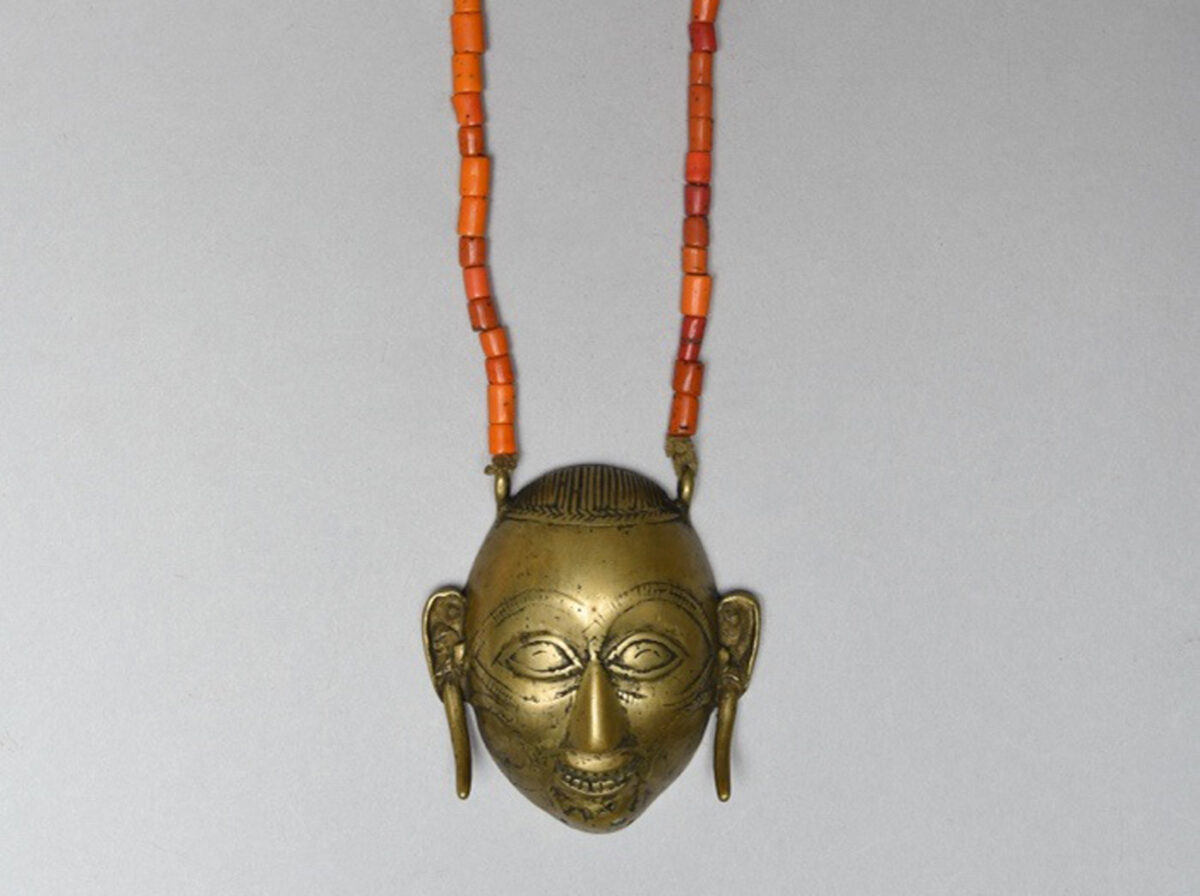
The auction at Woolley & Wallis this month, will offer the opportunity to obtain rare one-off pieces made by the artisans of Nagaland in northeast India.
Within one of the most extensive collections in private hands, of pieces from this little-known region, is a collection of jewellery that has inspired and continues to inspire contemporary jewellery today.
It is in the collection of the celebrated art publisher and artist Hansjorg Mayer, and has been amassed over a period of 50 years.
Mayer’s collection of jewellery and other works from Nagaland began accidentally, as friends had purchased a work at auction that had been produced in the region.
It intrigued him so much, that he offered to buy it from them. This would initiate a lifelong fascination with the area and the pieces created there.
The collection of jewellery will be offered alongside these other works in a special auction titled Arts of Africa, Oceania and the Americas tomorrow (19 February).
The word ‘Naga’ derives from the Burmese word ‘Naka’, meaning people with earrings. Naga people are believed to have descended from early Austroasiatic and Tibeto-Burman-speaking groups, who developed their own distinct cultures and societies based on clans, each with its own language, set of customs, dress codes and social structures.
They were traditionally ‘animists’, believing in a supreme being and spirits, as well as the supernatural, which many of the pieces in this collection demonstrate. This changed in the mid-19th century when missionaries introduced Christianity to the region.
After India’s independence in 1947, the Naga people became Indian citizens and are more connected to mainstream Indian society today, however some still seek independence. They predominantly practice Christianity, alongside some of the more spiritual rituals inherited from their descendants.
Mayer says: “There was little known about Nagaland and its indigenous people in the 1970’s when I began collecting.
“A state in India’s northeast region, it is remotely situated among the hills and mountains bordering Myanmar to the east, Arunachal Pradesh to the north, Manipur to the south and Assam to the west.
“Not only was it difficult to get to, due to the terrain, but it was also difficult politically and therefore impossible to obtain travel documents for, so I disappointingly never got to go and see anything first-hand, even though I tried.”
Mayer would search for original pieces with full provenance from antiques dealers and auction houses around the world, as well as directly from some of the Naga people who would travel out of their region to trade in India.
Many of the pieces in the collection were featured in a seminal text on the Naga people titled The Nagas, Hill People’s of North East India, by Julian Jacobs, published in collaboration with Mayer’s own publishing house and Thames & Hudson in 1990.
The Nagas practiced exceptional craftwork and jewellery-making led the way. Each ancient tribe in Nagaland had a different style of jewellery that would help identify them. Worn by both men and women, Jewellery bore symbols and motifs that had a deeper meaning.
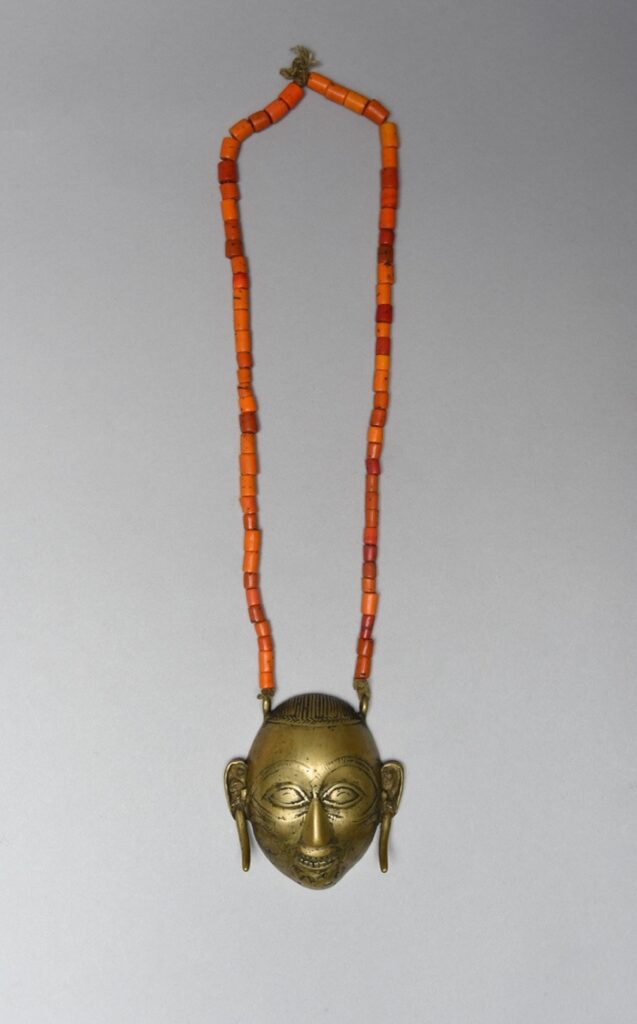
The head is shown in many pieces, with the belief that the head holds all spiritual divinity in a body. It also alludes to the more sinister ritual of head-hunting, as the Naga men were warriors.
Jewellery worn by men in Nagaland, was influenced by their warrior traditions and therefore incorporated weapon motifs and animal parts such as teeth and feathers, while the women’s pieces were designed predominantly to be decorative.
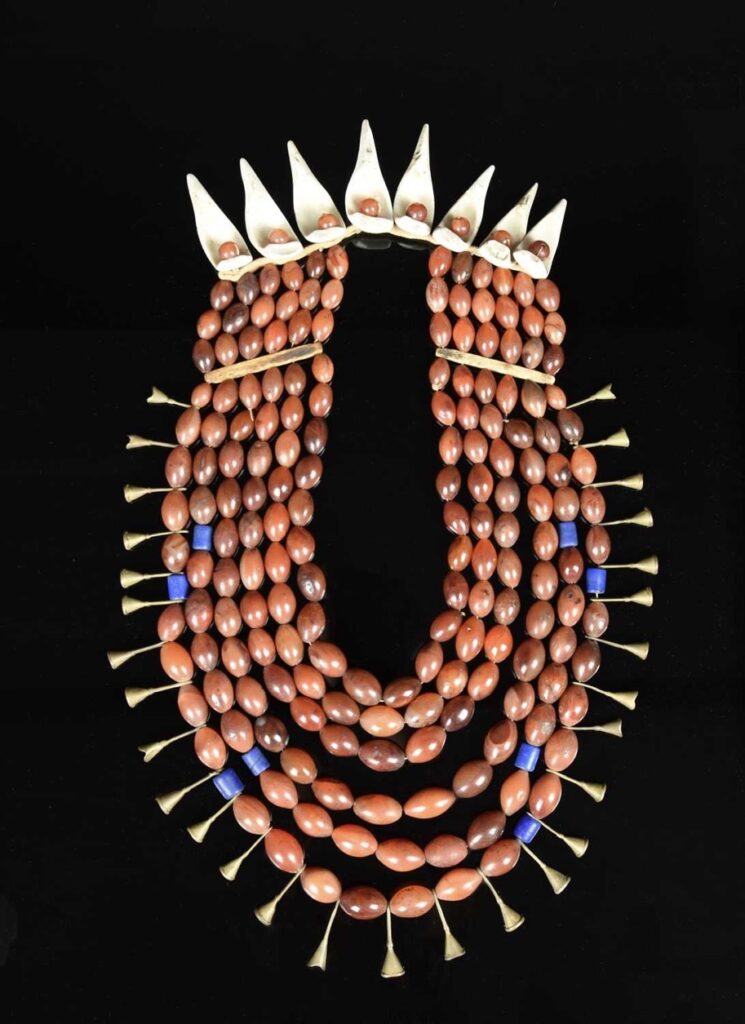
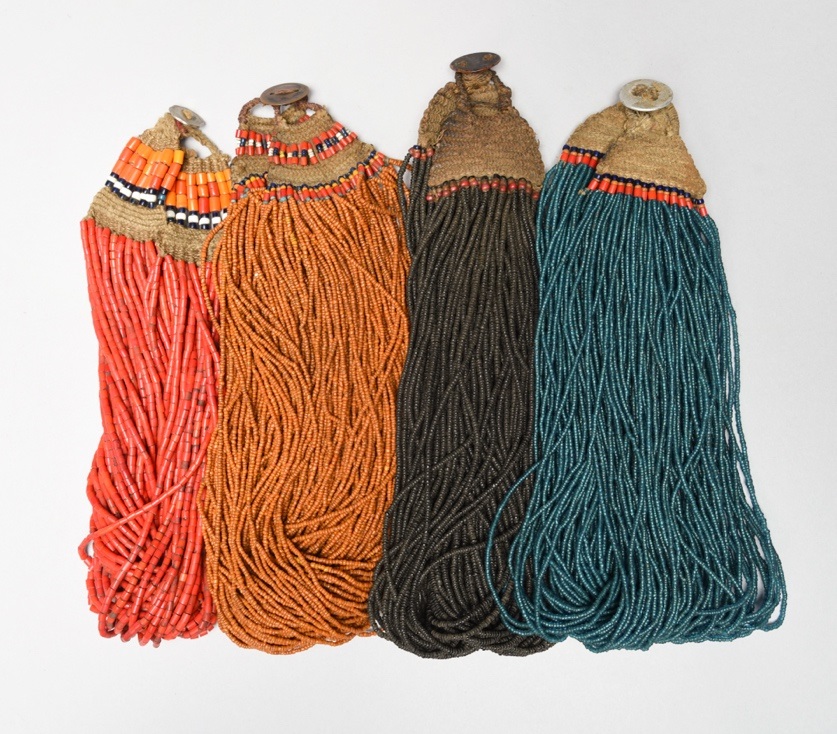
Nagas used a range of natural materials available in the hilly regions of the Indian northeast to create their jewellery, including coral, conch shells, carnelian and glass beads.
The ancient Naga tribes believed that each individual’s jewellery was inextricably bound to them and on the person’s death their most regularly worn piece was buried with them to go in their journey beyond life.
The jewellery collection in the sale spans highly decorative beaded necklaces in vibrant colours, as well as head and body ornaments. Among these is a large, vibrant woman’s necklace with graduated carnelian beads, bone spacers and brass bell pendants in contrasting colours, adding to its dramatic look.
Wide necklaces with lots of strands were usually worn by women, while Naga men often wore more streamlined versions. Beaded necklaces were created as a form of regalia, to show a person’s status and wealth, as well as certain ceremonies, festivities and celebrations.
Skilled craftspeople in their own right, the Naga people created jewellery with rudimentary tools, that was often elaborate, patterned and in contrasting textures and colours.
The varying elements that the necklaces were comprised of were considered a form of currency within the Naga tribe and were used for dowries, as well as being passed down as family heirlooms.
The collection contains several different styles of Naga armbands, including a set of six brass versions in spiral form, incised with a linear and lozenge decoration and three pairs of brass bracelets with a decoration of chevrons, lines and scrolls. There are several groups of brass bracelets on offer, featuring various decorative elements.
